
CRITER Weekly Roundup
Wednesday, January 21, 2026

Hello, hello, and happy Wednesday!
One thing I’ve really been enjoying this week is the new disc golf course at Veteran’s Park, mere minutes from my house!!! Huzzah for Boise City Parks! We’re so lucky to have them.
Okay, let’s get to the AI.
Local AI
There’s a lot of congratulations to go around right now for folks who’ve been working hard on building AI capacity in our state.
First up, very cool to see boisestate.ai featured by Amazon Web Services recently--big shout-out to Phil Merrell (h/t Brian Bolt):
With AWS, Boise State targets three dollars per user per month, and current usage is under that target—more than 80% cost savings compared to the $7.2 million annual cost of individual commercial subscriptions. Instead of rushing an aggressive campus-wide promotion, the university took a soft launch approach in the first semester, prioritizing quality and user experience while gathering feedback before a broader rollout. Despite minimal marketing, adoption has grown organically month over month.
Second, a huge congrats to Liza Long and the Idaho State Board of Education for winning a $4m FIPSE grant from the Department of Ed! This is going to make a big difference for higher ed institutions in the state.
And finally, thanks to Christine Bauer for sharing this opportunity:
Practical Strategies for Driving AI Policy Adoption in Higher Ed
Free and Open to All | February 5, 12:00 PM MST
It’s 2026, and your institution has AI policies in place. So you’re covered, right? Not quite.
Join WCET and Honorlock to explore how colleges and universities can move beyond early AI governance to meaningful, campus-wide adoption that supports learning, assessment, and workforce readiness. You’ll gain practical strategies to evolve your policies, align with employer expectations, and build the processes needed for responsible AI use at scale. Register here.
AI and Higher Ed
A recent Google/Ipsos poll finds that Americans are among the most skeptical populations in the world when it comes to AI adoption and use. So maybe it’s no surprise that The Chronicle of Higher Education reports on a poll finding that faculty are mostly worried about its impacts:
A new faculty survey paints a bleak picture of the impact that generative AI tools are having on students and on the value of higher education. Ninety percent of instructors believe that generative AI will diminish students’ critical-thinking skills, and 78 percent said that there has been more cheating on their campus since these tools have become widely available. Nearly three out of four believe AI tools will diminish the integrity and value of academic degrees.
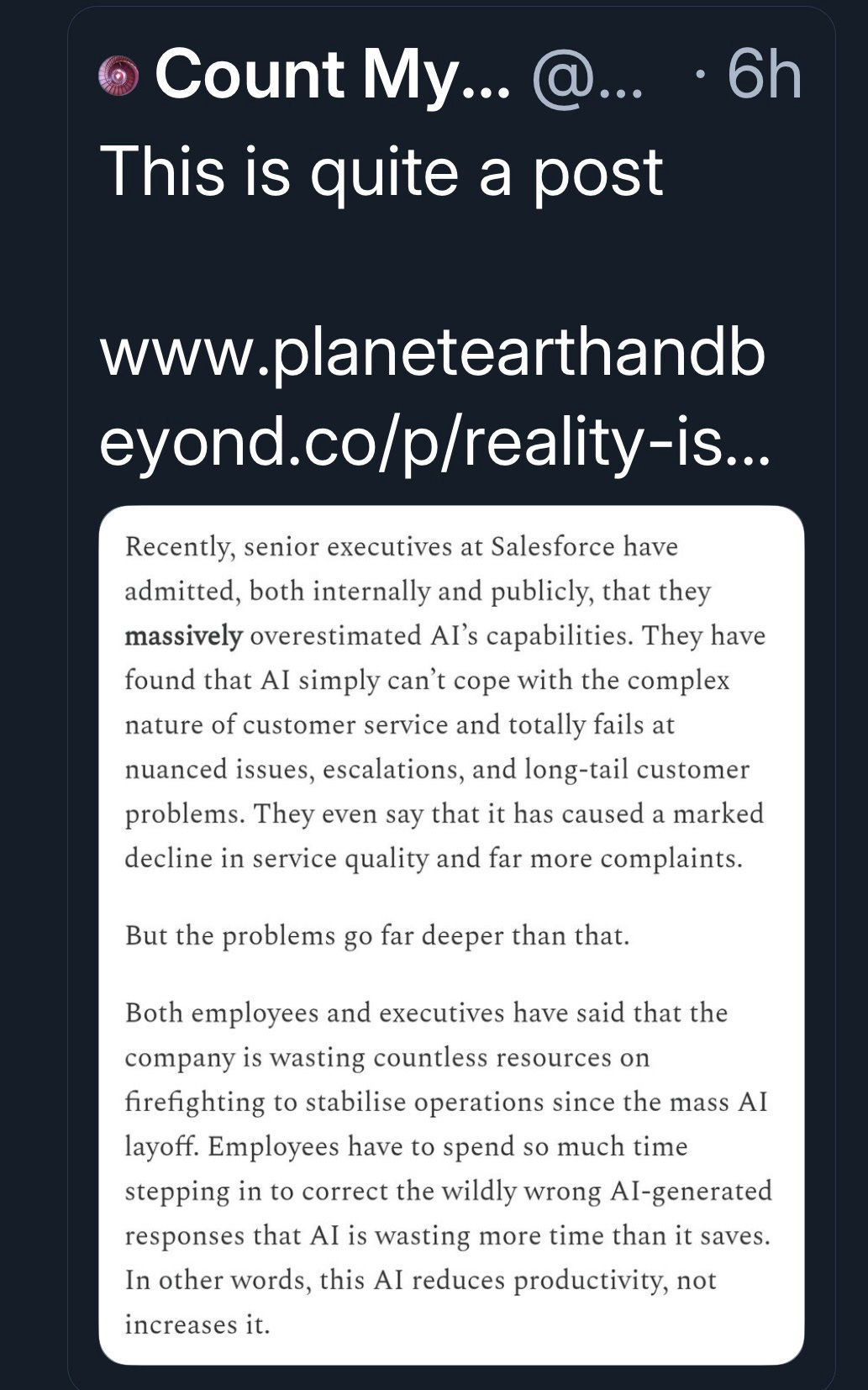
And, a paradox: This blog post argues that using AI in research might help solve the replicability crisis. But here’s an argument for why AI might be useful for individual scientists but overall bad for the scientific enterprise (h/t John Sides in Good Authority):
The problem is that what is good for scientists may not be good for science as a whole. Papers that use AI are more likely to succeed, but apparently less likely to stretch boundaries. Evans and his co-authors deploy another bespoke AI model to measure how AI-aided papers shape knowledge production. They find that AI-enabled research tends to shrink scientific inquiry to a smaller set of more topical questions. Furthermore, the linkages between papers suggest that there is less vibrant horizontal exchange associated with AI.
And dang, sorry to post another paywalled piece from New York Magazine, but Jeffrey Selingo wrote this one about the job market recent college grads are stepping into, and if you have a way to access the piece, it’s worth your time:
Only now are colleges realizing that the implications of AI are much greater and are already outrunning their institutional ability to respond. As schools struggle to update their curricula and classroom policies, they also confront a deeper problem: the suddenly enormous gap between what they say a degree is for and what the labor market now demands. In that mismatch, students are left to absorb the risk. Alina McMahon and millions of other Gen-Zers like her are caught in a muddled in-between moment: colleges only just beginning to think about how to adapt and redefine their mission in the post-AI world, and a job market that’s changing much, much faster.
In my view, it’s hard to blame universities for this mismatch. The job market and tech are evolving so much faster than anyone can really adjust to meaningfully, much less big institutions like universities. It’s just the morass we all find ourselves in right now, and we have to muddle through the best we can, building where possible, piloting to see what works, pivoting when necessary.
AI and the Culture
I’ve got some whiplash this week from reading essays arguing for the importance of AI, arguing that one mustn’t refuse to use AI, and arguing that AI is destroying everything that works about our civic institutions. Here’s a little sampler:
1) Like a lot of you, I’m obsessed with The Pitt, and am watching closely to see how a new storyline involving AI technology in the ER is going to evolve. An op-ed in the New York Times written by a UCSF Department Chair of Medicine argues that AI implementation is improving healthcare overall, though more guardrails are needed:
I am not arguing that we shouldn’t aspire to perfection or that A.I. in health care should receive a free pass from regulators. A.I. designed to act autonomously, without clinician supervision, should be closely vetted for accuracy. The same goes for A.I. that may be integrated into machines like CT scanners, insulin pumps and surgical robots — areas in which a mistake can be catastrophic and a physician’s ability to validate the results is limited. We need to ensure patients are fully informed and can consent to A.I. developers’ intended use of their personal information. For patient-facing A.I. tools in high-stakes settings such as diagnosis and psychotherapy, we also need sensible regulations to ensure accuracy and effectiveness.
But as the saying goes, “Don’t compare me to the Almighty; compare me to the alternative.” In health care, the alternative is a system that fails too many patients, costs too much and frustrates everyone it touches. A.I. won’t fix all of that, but it’s already fixing some of it — and that’s worth celebrating.
2) From Cristofer Moore, writing in Undark:
In accordance with this, many institutions and scholars are drafting strategies to preserve the quality of education in the face of AI. These policies deal squarely with the reality that AI is already a significant part of how people produce and consume information. We dread a future where students pretend to write essays and teachers pretend to read them; we agree that writing is thinking, and outsourcing either one is perilous. But in theory, AI can help close gaps in language, vocabulary, and access to knowledge that currently prevent many from enjoying the fruits of education. And part of this education must be empowering humans to look under the hood and behind the curtain, to understand how AI works and what it can and can’t do.
3) And in SSRN, legal scholars arguing that AI is incredibly destructive to civic institutions:
In this essay, we make one simple point: AI systems are built to function in ways that degrade and are likely to destroy our crucial civic institutions. The affordances of AI systems have the effect of eroding expertise, short-circuiting decision-making, and isolating people from each other. These systems are anathema to the kind of evolution, transparency, cooperation, and accountability that give vital institutions their purpose and sustainability. In short, current AI systems are a death sentence for civic institutions, and we should treat them as such.
And finally, I want to share this essay from CRITER member and College of Education faculty Ross Perkins. It’s definitely worth a read--lots of helpful links here--and I want to thank Ross for sharing this with all of us:
Our work as academics is not to wave the banners of AI company claims, reiterate their promises, and wax eloquent about their tools. Rather, our obligation is to hoist bright red flags that highlight the seriously problematic aspects of AI. The real danger of these technologies is neither that students might cheat on assessments nor that they might use the tools to take mental shortcuts. Those concerns are legitimate, as are concerns about job security, but a much greater danger exists: while we in the Global North engage in the “noble pursuits” of integrating AI across multiple sectors to achieve industry and educational outcomes, many people bear the actual consequences. Will we continue to skip past the oodles of bloodstains on the path to AI dominance, or will we acknowledge the multiple traumas and work to stem the suffering?
Do you have something you’d like to share with CRITER readers? Please send my way and I’ll make sure to post.
AI and the Environment
Fielding lots of questions about the energy and water consumption related to AI. My thinking, right now, is that AI development is still overall a net negative for the environment and likely also for ratepayers, but as with all things AI, that impact is going to be quite jagged. This article from today’s edition of Wired (paywalled) captures the complexity in trying to measure impacts, but suggests that we shouldn’t be throttling renewable energy production if we want to keep AI impacts low (duh?):
Predicting the amount of energy the US is going to need for AI in the future is an incredibly tricky project. Many of the public estimates we have are provided by utilities that are wrangling a number of requests for new capacity from data centers; data center companies often take their requests to a number of utilities as they shop for the best price, which inflates estimates of overall actual need. Technological advances over the next few years could also make data centers and AI much more energy efficient. Some of the craziest numbers splashed over headlines or trumpeted out by tech and energy executives are probably exaggerations. (Earlier this month, PJM, one of the largest regional transmission organizations in the country, downgraded its projections of how much energy the grid is going to need over the next couple of years after more carefully vetting some data center proposals.) In order to get an accurate read on this, UCS modelers used middle-range electric growth scenarios and assumed that just half the projects publicly announced in the pipeline would actually be built.
But the Trump administration has moved so aggressively against both renewable energy and climate policies in the past year that the analysis likely underestimates how high emissions from data center demand could actually be. While the UCS modeling accounts for some policy changes, including backpedaling on regulations on coal-fired power plants, doing away with renewable tax credits, and delaying some offshore wind projects, it didn’t take others into account. An Interior Department policy that has mandated review of all wind and solar projects on federal lands, for instance, has created a whopping bottleneck of 22 gigawatts of projects—enough to power more than 16 million homes. In December, the administration issued stop work orders for five East Coast wind farms under construction, citing national security concerns. (On Friday, three different judges ruled that construction could proceed.)
Tech Updates
Gemini is coming for your inbox:
Google this month began rolling out a suite of new tools relying on generative A.I., the technology driving chatbots, to help users manage their bloated inboxes and speed up the process of writing email. Some of the features are free, while others require paying a subscription.
Gmail users can now look up emails by typing a question, such as “What’s the name of the job recruiter I met last month?” Google is also testing a new type of inbox, set for release later this year, that automatically pulls together a to-do list based on tasks discussed inside emails. In addition, Google unveiled tools to streamline writing, including an automatic proofreader and response generator.
The article explores the security issues related to the rollout, and reminds us we’ll have to opt-out of these services--we’re enrolled automatically.
Next up: according to the MIT Technology Review, researchers are seeing some (unevern) gains in understanding what’s happening under the hood of large language models (h/t Kelly Arispe):
For years, we have been told that AI models are black boxes. With the introduction of techniques such as mechanistic interpretability and chain-of-thought monitoring, has the lid now been lifted? It may be too soon to tell. Both those techniques have limitations. What is more, the models they are illuminating are changing fast. Some worry that the lid may not stay open long enough for us to understand everything we want to about this radical new technology, leaving us with a tantalizing glimpse before it shuts again.
There’s been a lot of excitement over the last couple of years about the possibility of fully explaining how these models work, says DeepMind’s Nanda. But that excitement has ebbed. “I don’t think it has gone super well,” he says. “It doesn’t really feel like it’s going anywhere.” And yet Nanda is upbeat overall. “You don’t need to be a perfectionist about it,” he says. “There’s a lot of useful things you can do without fully understanding every detail.”
And, not a tech update exactly, but Wikipedia announced that it has struck some deals with AI companies to ensure the non-profit is paid for training large AI models (they all trained on Wikipedia, to my understanding, so this is kind of reparations as opposed to selling out).
Bite-Sized AI
Yet again out of time to do a bite-sized AI, but thought I’d share these two things:
As a Gmail user, I have yet to experience my email being infiltrated by unwanted AI products. Perhaps our university has disabled this functionality, or I did at some point unknowingly, but I haven’t seen it yet.
And I’ve been giving a lot of talks lately, on a variety of topics. It’s been extremely helpful to use both chatgpt.edu and Claude to brainstorm the structure of the talks. I didn’t know what I wanted to say for one of the talks and was feeling procrastinate-y, so asked it to interview me about the topic. We had a back and forth for about a half-hour with me answering the bot’s interview questions, and then it proposed an outline for the presentation, which I immediately ignored. But answering the interview questions got me going enough that I was able to get started and complete the thing. For me, overcoming dread and resistance (even for things I really want to do, actually) is the number one use case for AI so far.
Okay, that’s it for me! Talk to you next week,
Jen